
Historically, lumbar fusion surgery requires a large incision to be made on the back, and healthy muscle tissue must be removed in order to access and operate on the spine.
Because of the volume of tissue affected by such an operation, recovery time for such a procedure used to extend for months. It was also common to injure the adjacent levels, requiring revision surgery later.
However, minimally invasive techniques allow trained surgeons to perform the same procedure with a few small ½ inch incisions. During a fusion, the disc between the vertebrae is carefully removed. We then insert a spacer between the bones that allow for the bones to grow together and take the pressure off the nerves.
Fusions can be performed through incisions on the back, the flank, or the abdomen. At the Saville Spine Institute, we will find the best approach for you and your problems.
The end result is the same pain relief and stabilization of the spine but with far less inflammation of surrounding tissue, making post-operative recovery substantially less painful and time-consuming for our patients. Minimally invasive procedures also show lower complication rates than conventional procedures.
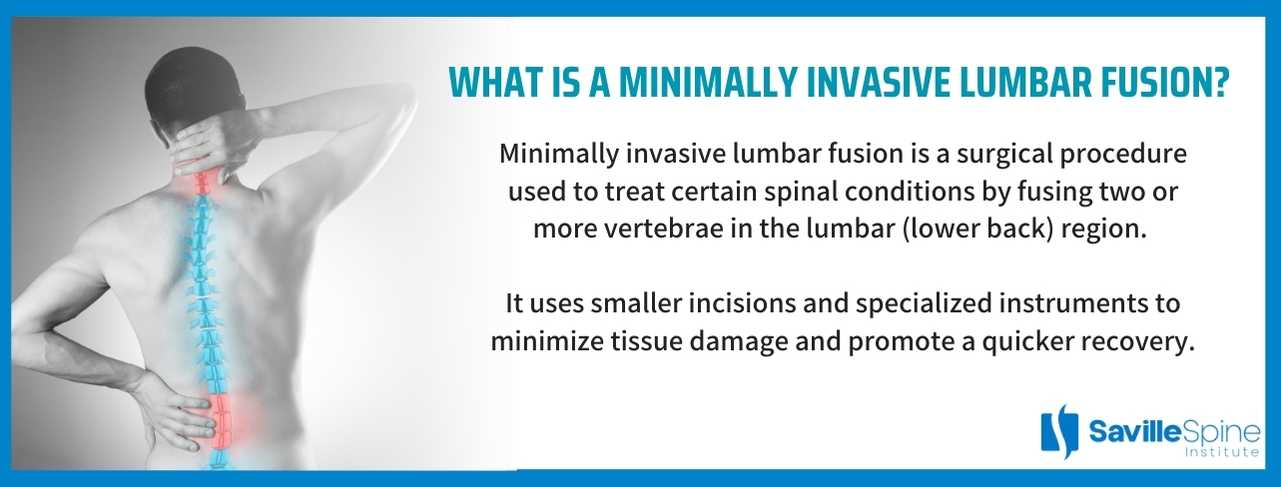
Minimally invasive lumbar fusion is a surgical procedure used to treat certain spinal conditions by fusing two or more vertebrae in the lumbar (lower back) region.
It uses smaller incisions and specialized instruments to minimize tissue damage and promote a quicker recovery.
Minimally invasive spinal fusion is used to treat various spinal conditions and disorders that cause chronic lower back pain, instability, or nerve compression in the lumbar (lower back) region. Some examples include:
- Degenerative disc disease
- Spondylolisthesis
- Herniated discs
- Spinal stenosis
- Spinal fracture
- Tumor or infection
- Failed back surgery syndrome
It is typically considered when conservative treatments, such as physical therapy, medications, and lifestyle modifications, have not provided sufficient relief.
A good candidate for minimally invasive lumbar fusions is typically someone with specific spinal conditions or disorders in the lumbar (lower back) region that have not responded to conservative treatments. The patient should also meet the following criteria:
- Good general health without severe medical conditions that would increase the risks associated with surgery.
- Non-smoker or willing to quit smoking before the surgery.
- Willing and able to engage in the rehabilitation process.
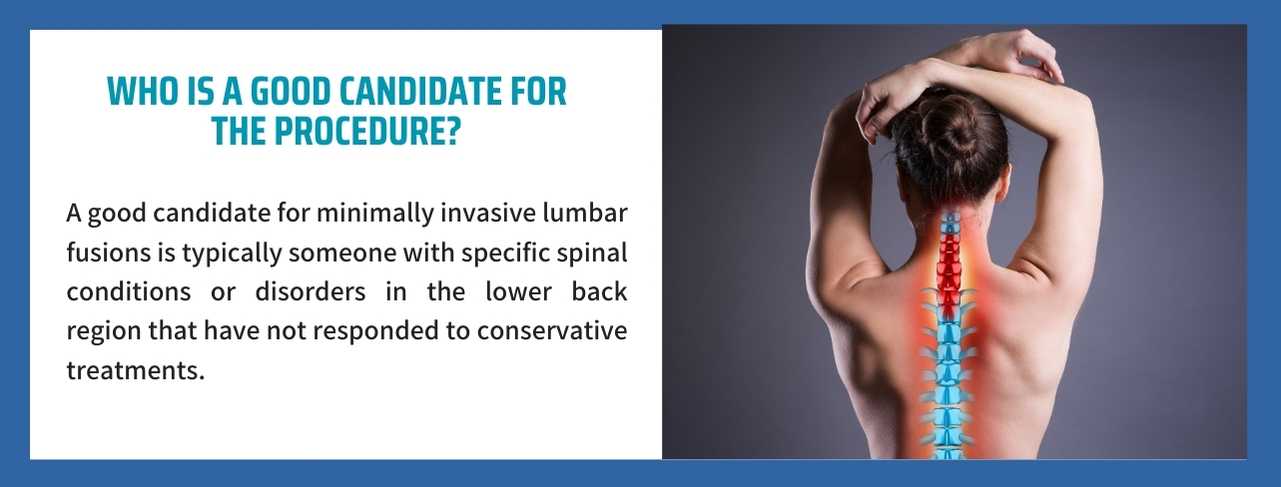
The decision to undergo the surgery is made on a case-by-case basis. A thorough evaluation by a spine specialist is also necessary to determine if the procedure is appropriate.
The critical difference lies in the surgical approach. A minimally invasive spinal fusion involves smaller incisions, reduced muscle and tissue disruption, and less post-operative pain than traditional open lumbar surgery. Patients usually experience a faster recovery with minimally invasive techniques.
Preparing for the procedure is crucial to ensure a safe and successful surgery. Here are some of the important things you should do:
- Complete any pre-operative medical tests and evaluations required by your surgeon. These may include blood tests, imaging studies, and an assessment of your overall health.
- Consider quitting or at least reducing your smoking habits. Smoking can impede the healing process and increase the risk of complications.
- Maintain a healthy diet to support healing. Ensure that you are well-hydrated in the days leading up to surgery.
- Prepare your home for your return after surgery. Arrange for help with daily tasks, such as meal preparation, cleaning, and shopping. Consider making your living space more accessible and safe.
- Ensure you have transportation to and from the hospital on the day of surgery. You won’t be able to drive immediately after the procedure.
Remember to follow your surgeon’s specific instructions closely, as they may vary depending on your unique situation and the surgical facility’s protocols.
Recovery times can vary from person to person, but most patients can return to light activities within a few weeks. Full recovery and a return to more strenuous activities may take several months.
The recovery period following minimally invasive spinal fusion is a crucial phase in the treatment process. Here’s what you can expect during this period:
- Hospital stay: You may spend a day or more in the hospital for monitoring and initial post-operative care. Some patients may be discharged on the same day of surgery if they are deemed stable.
- Pain management: Your medical team will provide pain management options, including medication, nerve blocks, or epidural injections.
- Restricted activities: You’ll be advised to avoid certain activities, such as heavy lifting, bending, twisting, and strenuous physical activity, for a specified period.
- Wound care: provide instructions on how to care for the incisions and when it’s safe to remove any dressings or bandages.
- Follow-up appointments: You’ll have follow-up appointments with your surgeon to monitor your progress and assess the fusion site’s healing.
Physical therapy is often a part of the recovery process. A physical therapist will work with you to improve your strength, flexibility, and overall mobility. It will also help you return to normal daily activities, work, and recreational pursuits.
Physical therapy programs are tailored to the individual patient’s needs, taking into account their specific condition, age, fitness level, and surgical procedure. The therapist will adjust the program as the patient progresses.
While lumbar fusions can provide substantial pain relief for many patients, it does not guarantee complete and permanent pain relief.
The procedure’s success depends on various factors, including the underlying condition and individual response to treatment.
***
The material contained on this site is for informational purposes only and DOES NOT CONSTITUTE THE PROVIDING OF MEDICAL ADVICE, and is not intended to be a substitute for independent professional medical judgment, advice, diagnosis, or treatment. Always seek the advice of your physician or other qualified healthcare providers with any questions or concerns you may have regarding your health.
Patient Report
Here’s what one of our patients has to say about their MIS lumbar fusions treatment:
Dr Saville fixed my back.. I could not even walk around the block without being in such pain you could not belive. Now I feel no pain and can swim and walk and dance .. and in a couple of months back to working out...I feel great !! I had two rods and a spacer and a discetomy and with very little incisions ...it was about 5 weeks and you can barely see them ..He and his staff are Super nice and helpful and friendly ..I highly recommend Dr Saville and I have ...and now my family and friends, if need be.. he will be the doctor that they will go see
Lynn B