
Minimally Invasive Surgery vs. Other Treatment Options
Are you considering surgery but worried about the risks and long recovery associated with traditional methods? Minimally invasive surgery might be the game-changer you’ve been waiting for.
Minimally invasive surgery has emerged as a revolutionary approach to treating various conditions. But how does it stack up against other treatment options like open surgery and non-surgical interventions?
In this blog post, we will discuss the nuances of minimally invasive surgery, exploring its advantages, disadvantages, and risks, ultimately empowering you to make informed decisions about your healthcare journey.
What is minimally invasive surgery?
Minimally invasive surgery (MIS) is a modern surgical approach that aims to minimize the impact on the body using smaller incisions, specialized tools, and innovative techniques.
Unlike traditional open surgery, which often involves large incisions and significant tissue disruption, MIS procedures are performed through tiny openings, sometimes as small as a few millimeters.
Minimally invasive surgery vs open surgery
Open surgery, the conventional surgical approach, involves large incisions to access the surgical site. While effective for many procedures, it often leads to increased pain, longer hospital stays, and a prolonged recovery period.
Minimally invasive surgery, on the other hand, utilizes specialized tools and techniques, such as laparoscopy and endoscopy, to perform surgery through tiny incisions. This results in less trauma to the body, reduced pain, minimal scarring, faster recovery, and a quicker return to normal activities.
However, it’s important to note that not all surgeries can be performed minimally invasively. Open surgery remains the standard for complex procedures that require extensive access or manipulation of organs.
Minimally invasive surgery vs non-surgical treatments
Non-surgical treatments encompass a wide range of options, including medication, physical therapy, lifestyle changes, and injections.
These interventions can effectively manage certain conditions, especially in their early stages. However, they may not be suitable for advanced or complex cases where surgery is the only viable solution.
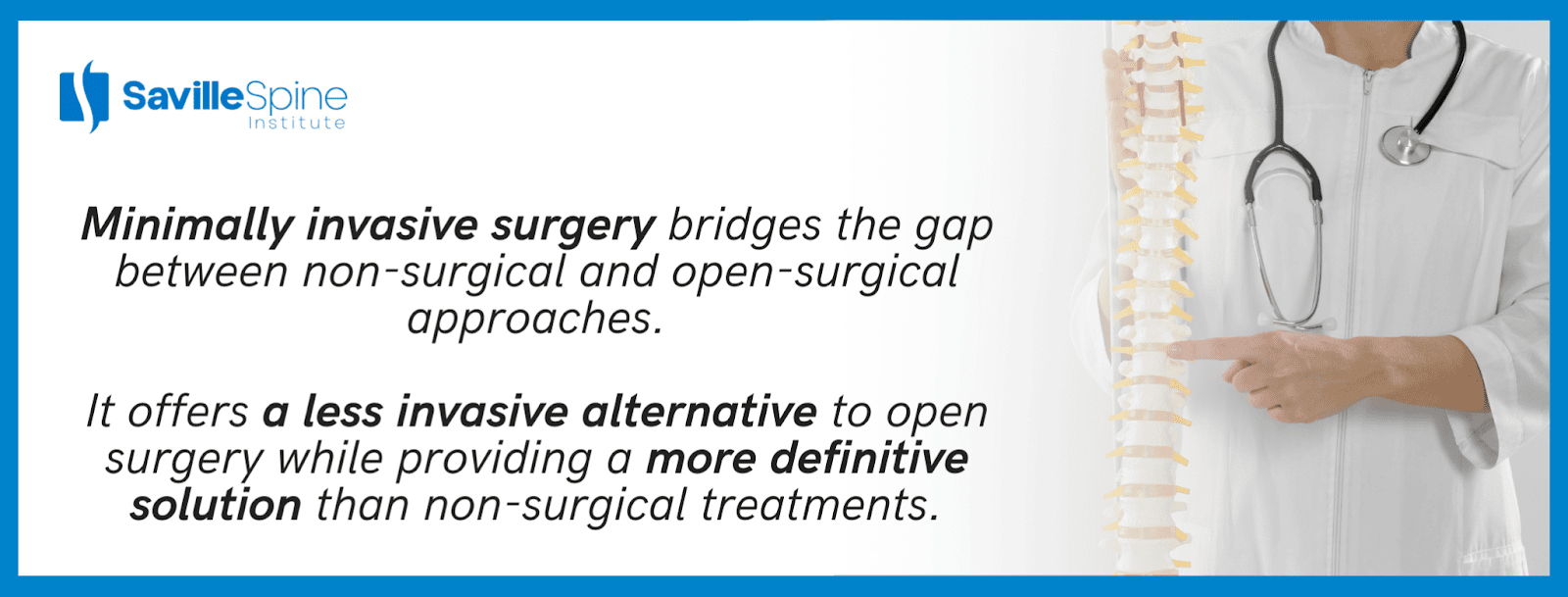
Minimally invasive surgery bridges the gap between non-surgical and open-surgical approaches. It offers a less invasive alternative to open surgery while providing a more definitive solution than non-surgical treatments.
Minimally invasive techniques for spinal surgery
Minimally invasive spinal surgery is a surgical technique that involves smaller incisions, less muscle dissection, and reduced trauma compared to traditional open spinal surgery. Some examples of minimally invasive techniques include:
- Discectomy: Removal of herniated disc material that is pressing on nerves.
- Spinal fusion: Joining two or more vertebrae together to stabilize the spine.
- Laminectomy: Removing a portion of the vertebral bone to relieve pressure on the spinal cord or nerves.
- Vertebroplasty/Kyphoplasty: Injecting bone cement into fractured vertebrae to stabilize and reduce pain.
- Spinal cord stimulation: Implanting a device to deliver electrical impulses to the spinal cord to manage chronic pain.
What are the benefits of minimally invasive spinal surgery?
When it comes to spinal surgery, minimally invasive techniques offer a lot of advantages over other treatment options.
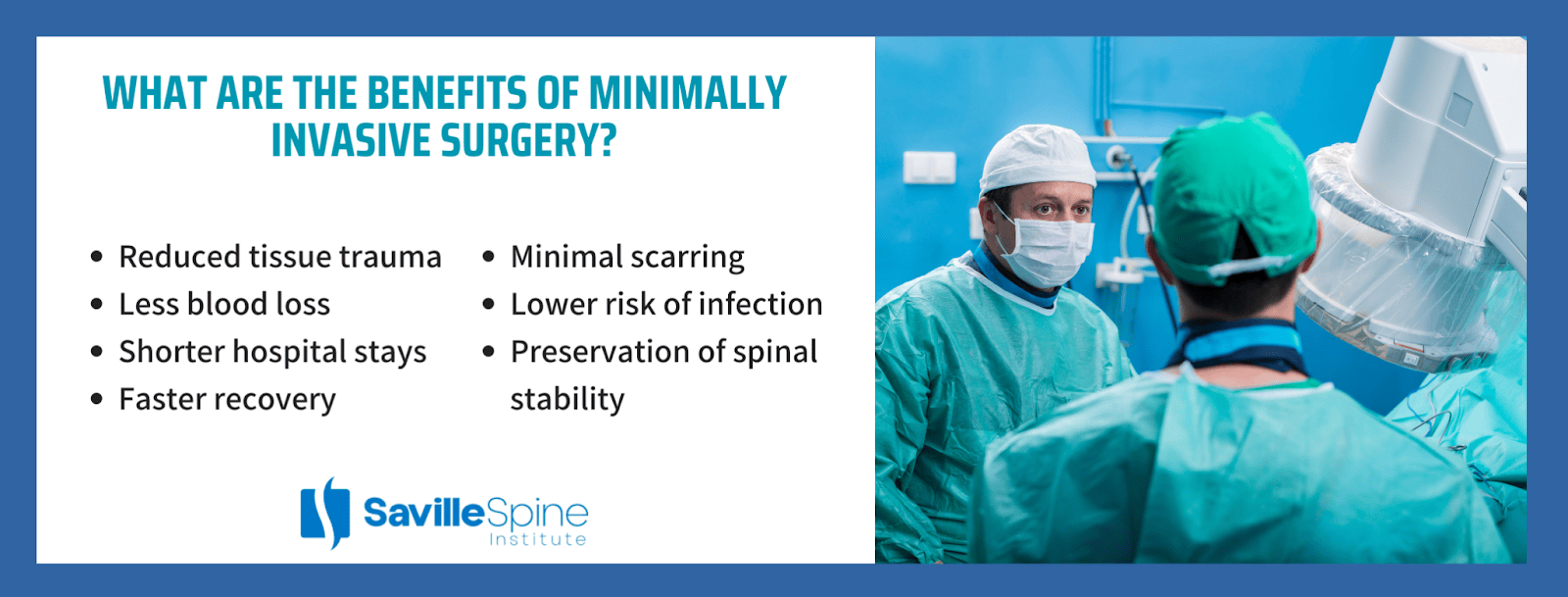
This includes the following:
- Reduced tissue trauma
Smaller incisions mean less damage to muscles, ligaments, and other tissues surrounding the spine. This leads to reduced post-operative pain, faster healing, and a lower risk of complications.
- Less blood loss
MIS techniques typically result in less blood loss compared to open surgery. This is beneficial for patients who may have concerns about blood transfusions or those with certain medical conditions.
- Shorter hospital stays
Due to reduced trauma and faster recovery, patients undergoing minimally invasive surgery often experience shorter hospital stays. This translates to cost savings and a quicker return to the comfort of their own homes.
- Faster recovery
The reduced tissue trauma and pain associated with MIS contribute to a faster recovery time. Patients can often resume their normal activities and return to work sooner than those who undergo open surgery.
- Minimal scarring
The small incisions used in minimally invasive surgery result in minimal scarring. This is particularly appealing to patients concerned about the cosmetic aspect of surgery.
- Lower risk of infection
Smaller incisions reduce the risk of infection compared to more extensive open wounds. This is crucial for any surgical procedure, as infections can lead to significant complications and delays in recovery.
- Preservation of spinal stability
Minimally invasive techniques are designed to preserve the natural stability of the spine. This is achieved by minimizing disruption to the surrounding muscles and ligaments, which play a vital role in supporting the spine.
Is minimally invasive back surgery safe?
Minimally invasive back surgery is generally considered safe and effective for many spinal conditions. However, like any surgical procedure, the procedure carries some risks. These can include:
- Infection: Although the risk of infection is lower with minimally invasive procedures due to smaller incisions, it’s still a possibility.
- Bleeding: While minimally invasive surgery typically involves less blood loss than open surgery, some bleeding can still occur.
- Nerve damage: There’s a small risk of nerve damage during any spinal surgery.
- Dural tear: This is a tear in the dura mater, the protective membrane surrounding the spinal cord and nerves. It can lead to cerebrospinal fluid leakage and potentially require additional repair.
- Hardware failure: If implants (such as screws or rods) are used during surgery, there’s a slight risk that they could fail or become loose over time.
Saville Spine Institute: Your Premier Destination for Comprehensive Spine Care
Saville Spine Institute offers a full spectrum of spine care services, from diagnosis and conservative treatments to advanced surgical interventions.

Our team of experts will work with you to develop a personalized treatment plan tailored to your specific needs.
We also ensure that our modern facilities are equipped with the latest technology to provide our patients with the highest quality of care.
Whether you need the best minimally invasive spine surgery in Florida and concierge orthopedics services, we are here to help.
Contact us today to learn more. Discover how our spine institute in Florida can help you achieve optimal spine health!
The material contained on this site is for informational purposes only and DOES NOT CONSTITUTE THE PROVIDING OF MEDICAL ADVICE, and is not intended to be a substitute for independent professional medical judgment, advice, diagnosis, or treatment. Always seek the advice of your physician or other qualified healthcare providers with any questions or concerns you may have regarding your health.
